
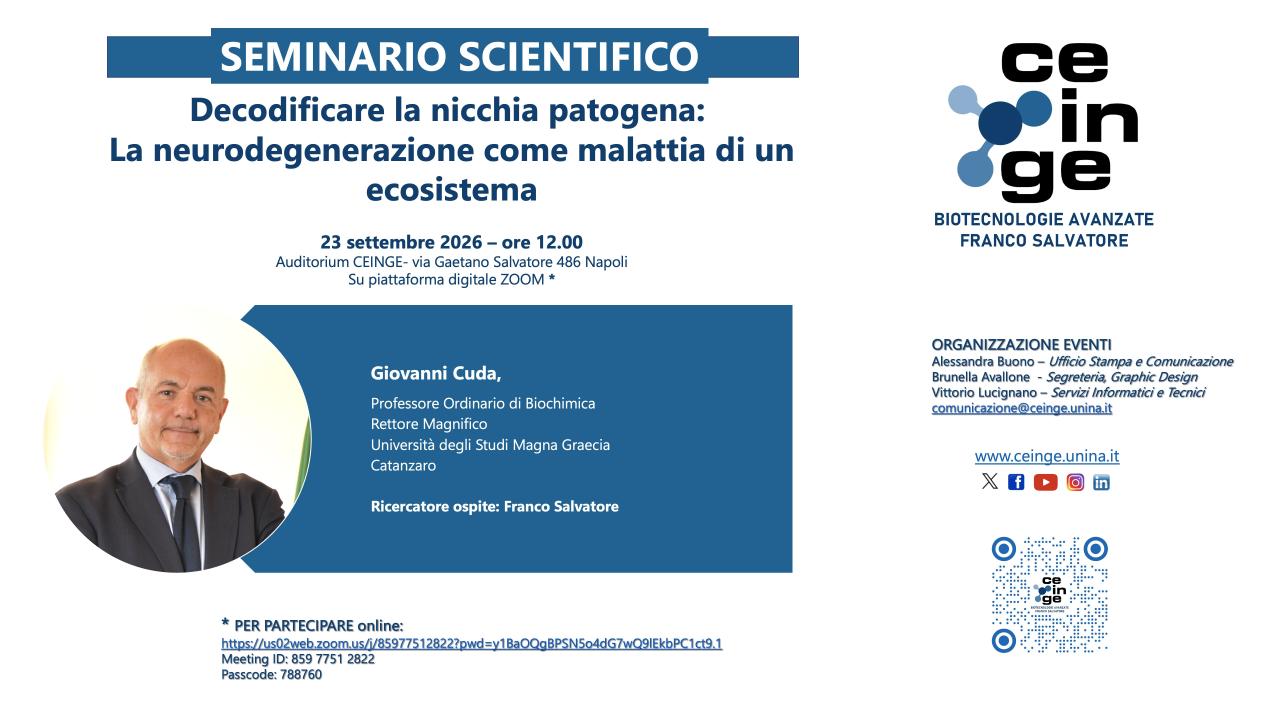
Decodificare la nicchia patogena: La neurodegenerazione come malattia di un ecosistema
Giovanni Cuda, Ordinario di Biochimica presso l'Università degli Studi Magna Graecia di Catanzaro, terrà un seminario dal titolo "Decodificare la nicchia patogena: La neurodegenerazione come malattia di un ecosistema".
Il Professore Cuda è Rettore Magnifico dell'Ateneo e guida importanti progetti universitari focalizzati sulla ricerca e l'innovazione scientifica nel campo delle neuroscienze.
Biosketch
Giovanni Cuda, MD, is Rector and Full Professor of Biochemistry at Magna Graecia University of Catanzaro, Italy. He trained in molecular research at the National Institutes of Health in Bethesda, USA. His research focuses on the molecular mechanisms of human disease, with particular interests in proteomics and precision medicine, induced pluripotent stem cells, and 3D organoid models of neurodegenerative disorders. He has coordinated several national research programs and currently leads research activities within major Italian PNRR and PNC initiatives. He is also Director of the Clinical Biochemistry and Clinical Molecular Biology Unit at the Renato Dulbecco University Hospital. Professor Cuda has authored more than 200 peer-reviewed publications and has an H-index of 62.
Abstract
Neurodegenerative disorders are traditionally viewed as primarily neuron-centered diseases, with therapeutic strategies largely targeting late-stage neuronal dysfunction and protein aggregation. However, the limited translational success of these approaches suggests that pathogenic mechanisms may begin much earlier and involve the surrounding cellular and extracellular microenvironment.
Here, we propose a shift from a neuron-centric model to a multicellular ecosystem perspective of neurodegeneration. Using patient-derived iPSC-based mosaic organoids as experimental models, we investigated early cellular and molecular events associated with neuronal vulnerability. Our findings indicate that alterations in the microenvironment, particularly involving vascular/leptomeningeal-like cells and extracellular matrix remodeling, can precede overt neuronal degeneration. These changes are associated with aberrant mechanotransduction and activation of interconnected TGF-β, AKT/mTORC1 and RhoA/ROCK signaling pathways, ultimately affecting proteostasis, autophagy, tau trafficking and neuronal architecture.
Functional modulation of selected components of this pathogenic niche partially restores neuronal homeostasis, supporting a causal contribution of the microenvironment rather than a simple secondary response to neuronal damage.
These observations suggest that neurodegeneration should be considered, at least in part, as a disease of the cellular ecosystem, in which the extracellular matrix and cell–cell interactions shape neuronal vulnerability. Patient-derived organoid models may therefore provide a valuable platform for identifying early biomarkers and preventive therapeutic targets, opening new opportunities for precision approaches before irreversible neuronal loss occurs.
Ospita Franco Salvatore
* PER PARTECIPARE online:
https://us02web.zoom.us/j/85977512822?pwd=y1BaOQgBPSN5o4dG7wQ9lEkbPC1ct9.1
Meeting ID: 859 7751 2822
Passcode: 788760
80131 - Napoli - NA